
The New Rules of Work

The New Rules of Work
In business, there are assets, things that add or increase in value, and there are liabilities, things that must be paid for or are a cost to the business. All employees have the opportunity to be real assets – but not all employees are working to their full potential. Be an asset. Grow yourself, be worth more, do more, produce more, and think about more than you’re paid to think about. Be an asset and your career will flourish. You’ll attract the things you’ve always wanted out of a career: more money, work that you’re passionate about, a mission that makes a real difference. On the other end, if you’re a liability and don’t take the tough assignments, skip meetings, disengage, and just do the minimum, you won’t get more out of the role than you create in economic value. Yes, some people just want a job to pay the bills – and that’s ok! But after 30 years of working with employers and the workforce, I have found that there is a significant gap between what people want from their career and what they’re actually getting out of their career. Did you know that 1 in 5 workers in the US is going to change jobs this year as people continue to get vaccinated and the pandemic eases? Pre-pandemic the number was closer to 1 in 3 workers. From another study, 51% of all workers are pondering a change in scenery and wondering if the grass really is greener on the other side. So, why is the workforce so darn dissatisfied with their status quo? Why do they feel the need to change jobs? There are many possible reasons, but I’d like to propose a different narrative as to why employees are not happy: the rules of work changed, and no one teaches the rules. Work typically has been defined as punching in, doing the job, and then punching out. Don’t do any more or less than your boss tells you. Color within the lines, follow the rules and keep the workflow moving. Today, more jobs than ever require an entrepreneurial spirit – no matter what the official job description says. Companies expect their employees to create more value than they’re paid and to proactively find other areas that they can make an impact. It’s the only way companies make it. An employee’s job is to make money for the company and to produce more than they cost. If this shocks you, that’s my point. Before I go on, let me just say – I am in no way proposing you work 16-hour days and neglect all other aspects of your life. I’ve been there, and if you’ve been part of this community for a while, you know that being a workaholic wreaked havoc on my physical and mental health. To create value beyond what you’re paid, you must take risks. You must try new ideas. You must serve customers when you can’t get your boss on the line in time. This can all happen within your 40-hour work week – you don’t need to work overtime to have a bold idea. When I talk with Presidents and CEOs of companies, they often have similar goals and challenges – almost all of them related to the changing requirements of the new rules of work. So, if the new rules of work mean thinking outside of your job description, where do you even begin? Try these things: 1) Employers say: “My employees need to understand change, our strategic plan requires it. We are entering new markets and our positions require different skill sets than they did before.”

What employees can do: Become a change maker.

Becoming a change maker doesn’t happen overnight, it’s a skill you hone over time. Reading really helped me – my favorite book about change is “Our Iceberg is Melting”. Everything in life and business is evolving and changing. We all must be experts at change management – whether you’re the leader who brings the troops along or the teammate who proactively supports business transformation. 2) Employers say: “Today’s workforce is lacking interpersonal skills and emotional intelligence. There are plenty of folks that know technical stuff. We need leaders and project managers that know how to work with different people.” What employees can do: Work on their interpersonal skills. I took Dale Carnegie’s Introduction to Human Relations course where I studied public speaking and learned how to navigate people and challenging conversations. This helped me develop my own values and an understanding of what I stood for. In business, the everyday study of “people” is more important than any degree. Interpersonal skills are critical. 3) Employers say: “We need everyone in our company to be a good teammate. We all need to have each other’s backs as we work towards our transformative goals.” What employees can do: Make becoming a good teammate a priority. Very few jobs are solo acts and great work is rarely done in a vacuum. Would you say that you’re a good teammate? Do you encourage others’ ideas? Do you help motivate and inspire? If you have a bold idea, do you bring others along for the ride or keep it to yourself? Most importantly: Can your team depend on you? The new rules of work require businesses and employees to operate differently. Leadership, culture and work norms must change, and an entrepreneurial spirit is more important now more than ever. Hey workforce: you have what it takes to get ahead – start acting on those bold ideas and color outside of the lines. Have you noticed a shift in the rules of work? What other ways can employees adapt to changing employer expectations? If you’re an employer, what are you looking for from your people? Please reply and let me know. Until next time, Chris

Want to receive Outside Insights in your inbox?

Subscribe to Outside Insights

Listen to the Outside Insights Podcast Listen on Google PodcastsListen on Apple Podcasts


At Placers we are making the following Acts of Kindness Promises: We will be your career coach free of charge to assist you with any and all part of your job search. We currently have temporary work for folks that need short-term funds. We will act as a consultant to businesses that need a 90-day plan – free of charge. We promise to go above and beyond in our individual communities. If you need help in any way, simply fill out this quick form and we’ll connect you with a helping hand. No strings attached.

How Do You Measure A Successful Life Lived?

How Do You Measure A Successful Life Lived
At face value, the definition of success can feel pretty narrow. Growing up, many of us are told that to be successful we need to go to college, land a well-paying job, work up the ladder, receive hefty raises, contribute to our 401(k) and then retire with a healthy retirement and time to finally do what we want. But what if, instead, “success” was all of the smaller moments that happened between point “A” and point “B”. The moments we often overlook and take for granted: Saturday’s spent at our kid’s baseball tournament, walks down the block, time spent covered in paint from crafts or home improvement projects – time spent smiling. Those moments aren’t just “nice to haves” on your way towards success – they’re the only ones that really matter. I’ve spent most of my life planning and working to achieve the next goal and then the next one and the next one after that. For a long time, I believed the more I got done and the more I achieved, the more successful I was. Don’t get me wrong, working hard helped me become good at what I do. I gained the gifts of knowledge and expertise. I got good at leading and the years of burning the midnight oil shaped me into who I am today. Yet, this approach came at the sacrifice of just about everything else – family, health, friendships, and hobbies. This certainly did not make me happy and it didn’t make me successful. Ask yourself, is success simply a measure of how much you’ve accomplished in any given day, week, or month? Is success a measure of how much money you make? Perhaps not. At least, not when you have enough to pay your bills and live comfortably. In fact, study after study says that after you start earning 75k a year, money does not increase your happiness. Money buys time and things, but that only equates to happiness up and to a certain point. Many people think success means working for yourself and being able to define how and when you work. Yes, I have flexibility today, but that’s because I had absolutely no flexibility 20 years ago. Are you willing to go without for years, so that someday you can have more time and money? Or is this just time and cost shifting? Either way, working for yourself does not always equate to success. I’m not here to say that any definition of success is wrong or right. I am, however, stressing the importance of really taking the time to reflect on what you’re working for and compare it against what you already know to be true of yourself. When are you the happiest? When are you the most content? When do you feel the spark in your soul that reminds you that You. Are. Alive. Whatever that is – that’s what success feels like. You shouldn’t be working most of your life in hopes that you can bask in success after retirement. No – you need to figure out how to feel successful every day. Most of the time, it’s as simple as shifting your perspective. I asked my network what their definition of success was. I polled my network on LinkedIn and asked them what definition of success they were working towards. Only 3% said an abundance of wealth, 29% said thriving relationships and a secure and stable future, and the majority, 39% said freedom for their time and energy. I’m with the 39% on this one. How about you? My journey in life has given me clarity into what matters most to me. I want to be happy. I learned later in life that I have that choice and that happiness has little to do with money or possessions. After years of working towards some arbitrary and fleeting measure of success, I made the intentional and resolute decision that I would control my happiness. That true success meant that I have the time and space to do whatever I want. Time to create and think, to write and to focus on being the best version of myself. To me, success also means having the privilege to use my time and resources to give back. To leave a legacy by positively impacting others throughout this journey called life. The mark of any great life is what we leave behind, and personally, I achieve this by creating a community at Placers. A community that can live their best life with the tools, operating philosophies and values that we instill. I want my community to want to work towards being their best selves. As always, I strongly encourage you to reply and let me know your thoughts. We’re all one community and I learn from every single one of you that takes the time to share their experiences with me. How do you measure success? How has this definition changed through the years? What is one thing you would tell your younger self on the topic of success? Until next time, friends.

Chris


Want to receive Outside Insights in your inbox?

Subscribe to Outside Insights

Listen to the Outside Insights Podcast Listen on Google PodcastsListen on Apple Podcasts


At Placers we are making the following Acts of Kindness Promises: We will be your career coach free of charge to assist you with any and all part of your job search. We currently have temporary work for folks that need short-term funds. We will act as a consultant to businesses that need a 90-day plan – free of charge. We promise to go above and beyond in our individual communities. If you need help in any way, simply fill out this quick form and we’ll connect you with a helping hand. No strings attached.

What Got Me Here Won’t Get Me There

What Got Me Here Won't Get Me There
This visualization represents my work/life story over the past 30 years. I imagine many of you can relate. To me work equaled independence. I started work early. From the age of nine, I had a paper route which I had until I was sixteen. It was hard work; I got up before school to deliver those papers but I learned I could make money through my hard work and I liked that. Over the years I had many jobs. I begged my parents to sign work papers when I was fourteen so I could work at a local pizza joint. I worked through college doing whatever I could. I parked cars. I worked in various roles at restaurants and caterers. I worked in landscaping. I even worked as an on-campus mailman. I thrived on hard work. I wanted more. More experiences, more knowledge, more responsibility. And, of course, more money to have the independence I craved. My parents became so concerned about my willingness to take any available job they decided they’d “help me” get a very demanding job as a mover. They wanted me to experience hard labor and, in the process, learn the value of higher education. Their plan backfired because I loved it. I was excited about making good money and the power of overtime. So, I continued to work. Fast forward, I did go to college and graduated. After a brief stint working in an outdoor retailer, I went to work in the family business. My dad, Alan, who has been a frequent guest of my podcast, made working hard look like a lifestyle that I wanted to emulate. We worked early, we worked late, we worked on weekends. Eight-hour days turned into 14-hour “workouts”. I was never told to work this way, I simply did it because I wanted to. Of course, the harder I worked the more I got rewarded. I was given more responsibility. I was tasked with hard projects. I was given bigger problems to solve. And, I gained the confidence that comes from those experiences. I had more work achievements under my belt than most of the other young people I knew. All of this helped me start my own business in 2001. So, I worked some more! I worked days, nights, weekends, holidays from early to late. My young kids would come to the office for dinner so they could see Dad. I felt, at times, that it was hard to breathe because of the pressure of starting a business with a young family. They needed me to succeed, so I worked some more. Until one day, I was at an event and saw a video of myself speaking and didn’t like what I saw. I was 38 and I looked tired, and puffy, and basically unwell. Thank goodness for that pivotal moment. I had sacrificed a lot for fear of failing in my business. I hadn’t been working out. I hadn’t been spending enough time with my family. I gave up weekends, and hobbies, and friends. I didn’t think that I had the time for anything that wasn’t work. It was easy to fall into this pattern. I had seen my father do it, and his father before him. They literally worked their way into sickness.

Was it worth it? Was there another way?

I reached a tipping point. I could no longer pour from an empty cup. I pushed through years of depleted energy, creativity, and perspective. Leaning into the wind wasn’t working for me any longer. Simply working hard and ignoring myself was no longer an option. Today I am a more balanced human. I work out, a lot. I meditate. I backpack with friends. I walk at least 10K steps every day. I love to sleep. Thanks to my wife, I am more careful about what I eat. I take time off and love to travel. I have found the balance between work and life that I thought I never could. You can find tips for quickly reducing your daily stress here. Don’t misunderstand, I still work hard. I just don’t work all the time. I could, because there is always something to do in a business that is working to thrive in this crazy world. I get into the flow of a workday and before I know it the day is over. I have learned, but must constantly remind myself, that leaders must be whole themselves to be effective in serving others. Leaders must also know themselves to be effective. We, ourselves, must be “ok” to help others be “ok”. I feel very lucky to be able to share this message. To have lived through it and to understand that work is better when it is tied to a life plan. And, that a life well lived makes work more important and vice versa. We strive to create a Placers community where our people are encouraged to understand this balance and to live their best life. We do this through company-sponsored wellness programs such as meditation and yoga. We do this through our Better Book Club where we encourage people to increase their knowledge on topics that interest them. We do this through flex time allowing our team to take the time for self-exploration or travel. We do this through access to our Dreammaker portal where our employees have access to support for finances, budgeting, or their big life goals. We do this, because we are all at our most productive when we take care of ourselves and find the balance that we need in life. When I finally understood that pausing to take care of me was critical in my journey towards success, I felt unstoppable. How do you measure success? Is it by the dollar signs, the property owned, the title, how fulfilled you feel, your family? There is no right or wrong answer – and it could be a combination of all of the above. Reply and let me know. I’d like to discuss this more specifically in a future Outside Insights. Until next time, friends. Chris

Want to receive Outside Insights in your inbox?

Subscribe to Outside Insights


At Placers we are making the following Acts of Kindness Promises: We will be your career coach free of charge to assist you with any and all part of your job search. We currently have temporary work for folks that need short-term funds. We will act as a consultant to businesses that need a 90-day plan – free of charge. We promise to go above and beyond in our individual communities. If you need help in any way, simply fill out this quick form and we’ll connect you with a helping hand. No strings attached.

The Importance of Knowing Yourself

The Importance of Knowing Yourself
Where does our confidence come from? How do I “fake it till I make it”? How do I know I am doing the right things with my life? I spend a lot of time with good people, customers, employees, friends, family and outside-inners that find value in our words and podcasts. The questions above are what seem to occupy people the most. Having recently read quite a bit about the philosopher Seneca, a word that comes to mind is “euthymia.” In Seneca’s essays on tranquillity, he defines euthymia as:

“Believing in yourself and trusting you are on the right path, and not being in doubt by following the myriad footpaths of those wandering in every direction.”

So, this belief in yourself comes from knowing yourself and putting the work in on you. Burkhards call this “your culture of one”. Often, we spend time on everything other than working on ourselves even though it can be done with relative ease, in 30 minutes or less per day. I recently led my company through a simple exercise during our monthly town hall meeting.

1 – First thing in the morning, decide what is most important to you that day. Pick one-three priorities. The most important doesn’t necessarily mean the most urgent.

2 – The second part seems easy enough. At midday, check-in on your plans and make an adjustment. Did you tackle your tasks for that day? If the morning got away from you, no worries. Adjust and focus the rest of the day.

3 – Fast forward to the end of the day. How did you do? Did you win the day? What did you learn and what can you apply to tomorrow? Were you the person you wanted to be today? Did you pick the right stuff to work on?

The interesting thing is, most people will find it easy to follow this plan for a day or even a week. Few will make this what it can or should be: A path of self-reflection and self-betterment. Study yourself. Do more of what you like, less of what you don’t, and learn who you are along the way. If you’re not sure where you are right now, here are some tools that can help:

Use this Planner Chart. I did not invent the concept, but seeing a heat map of your life in total with things like money, hobbies, friends and family, career and spirituality can give you a great starting point.

Take a look at Verne Harnish’s take on personal planning. I use this as a Scaling Up coach with clients. When you follow the link, click on the One Page Personal Plan. Consider purchasing the Scaling Up book by Verne Harnish for more insight.

It’s my belief that if you know yourself and are working on you you will not be distracted by the next shiny object that goes whirring by you. Back to Seneca. We learn by observing and seeing the world around us. It’s that exposure that helps us shape our core philosophies. It’s when we lack a clear set of personal core values that we bounce around from jobs, hobbies and relationships. So work on you – decide what you stand for. This will help you as you work towards your plan and vision for your life. You do have a plan right? Well, if not, we’ll talk more about that next time. As always, send your personal reflections to my cell or email. I look forward to learning and leading. Until next time, Chris

Subscribe to Outside Insights


At Placers we are making the following Acts of Kindness Promises: We will be your career coach free of charge to assist you with any and all part of your job search. We currently have temporary work for folks that need short-term funds. We will act as a consultant to businesses that need a 90-day plan – free of charge. We promise to go above and beyond in our individual communities. If you need help in any way, simply fill out this quick form and we’ll connect you with a helping hand. No strings attached.
Let’s Grow Again in 2021

Let's Grow Again in 2021
We’re eight days into January and it seems like all I read about is habit building, resolution setting, and how wellness is the key to my happiness. Now don’t get me wrong, I rock a daily plan, have a gratitude journal, I even review every week religiously for my wins and areas of improvement. And I always have annual goals. I thought goal planning for 2021 would be difficult. For a while, it really felt like 2020 had stole my spirit. Towards the back half of the year, the mantras that I live by day-to-day took a little longer to work, my heart and mind were weary. So many people around me experienced fear, anxiety, economic loss, hardship and pain around social issues and politics. I tried to compartmentalize and help where I could but, like many others, it was hard not to feel exasperated many days. We cannot change the past. Much of what happened in 2020 was simply beyond our control. Fighting with what happened is an unwinnable argument.

“God, grant me the serenity to accept the things I can not change, the courage to change the things I can, and the wisdom to know the difference.”

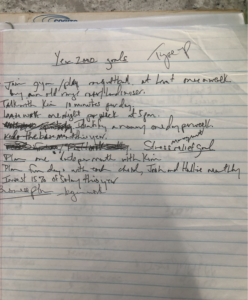
But you know what we can control, friend? How we respond in the present to position us for success in the future. Right here, right now – these present moments are the only ones that really matter. It can be hard to know how to make the most of the present when you don’t know which direction to start walking. This is where your Life List comes in. Think about things you want to accomplish in your your life. Think big. What do you think you’d regret if you never gave it a shot? What adventures do you want to experience? What makes you really, really feel alive? What do you dream about? Writing these dreams and goals down, is a powerful motivator, both consciously and unconsciously. Don’t judge the ideas that come to mind, just let them flow freely from your mind and on to your paper. Take a look at those goals and say aloud: “I am capable of achieving all of these. If I want them badly enough, I will make it happen. I am unstoppable.” Even if you don’t believe those words right now – one day you will. Keep repeating it until you do. Come back to your list every so often and pick a goal. Then, make smaller goals that will help you get there. Repeat the process until you have actionable steps that you can begin in the present moment. Work up from there. In one, five or ten years time, it will be pretty neat looking back at all that you’ve accomplished. In fact, I just uncovered my life list from 20 years ago! Man, that was fun to look back on. I am a lefty and arthritic, so no hand writing critics please! I like to create lists for each of the important aspects of my life. I have an adventure (Fun) list for travel and hobbies, Physical (Body) list for athletic goals, like hiking the Appalachian Trail or running a 5K. These things come naturally to me so they are always the ones I fill out first. But make sure you consider all the life categories to cover all the areas of your life. Some things for my Mind and Spirit, like taking time off or training for a new skill, are important for my overall well-being but take more thought. Get the idea? So whether you create a list for each category or list them all in one master list, get out of your comfort zone and consider the areas of your life that you may be neglecting. It will lead to a more fulfilling outcome as you begin to tackle your Life List. 2021 is the year to dream again. So, what will you start dreaming about? Until next time,

Chris


Subscribe to Outside Insights


At Placers we are making the following Acts of Kindness Promises: We will be your career coach free of charge to assist you with any and all part of your job search. We currently have temporary work for folks that need short-term funds. We will act as a consultant to businesses that need a 90-day plan – free of charge. We promise to go above and beyond in our individual communities. If you need help in any way, simply fill out this quick form and we’ll connect you with a helping hand. No strings attached.